
A lawyer may need clinical evidence to understand a claim, while a complete medical record also contains family histories, contact details and unrelated treatment. Before sending a copy, establish whose information is needed, for which question and by whom. Keep the source record intact and prepare a separate disclosure version for review.
Start with the request and its legal basis
Ask the requesting lawyer to identify the client, the matter, the intended recipient and the particular clinical question. A request for evidence of an injury may call for a different extract from a request about capacity at a specified time. Agree the scope before editing. Otherwise an apparently helpful attachment can expose years of unrelated history or remove information needed to interpret the evidence.
Health information falls within the special categories covered by GDPR Article 9. Article 9(2)(f) addresses processing necessary for establishing, exercising or defending legal claims. Its presence does not make every requested page necessary. An Article 6 basis and the other GDPR principles still matter. Record the basis actually applicable to the disclosure, including any relevant national or procedural requirements, before approving it.
The practical question is therefore specific: what evidence does this recipient need for this identified purpose? If the answer is unclear, obtain a narrower request. Treat a draft for legal advice, evidence required by an order and a teaching example as separate uses. Confirm the entitlement to receive a patient's file.
Separate clinical evidence from identifying detail
Work through the report by information type. Some details may be essential to the legal question, some help maintain continuity, and some add no value to the recipient. Article 5(1)(c) requires personal data to be adequate, relevant and limited to what is necessary. Apply that test to each disclosure.
| Information in the record | Review decision for the outgoing copy |
|---|---|
| Patient name and case reference | Retain only where needed to connect the evidence to the matter. |
| Home address, telephone, email and identifier | Check whether the recipient needs each individual field. |
| Clinical history and conclusions | Preserve relevant meaning; remove unrelated passages only after clinical review. |
| Relatives, teachers and other patients | Examine each person's relevance separately. |
| Appointment dates, school and unusual occupation | Consider whether the combination identifies somebody indirectly. |
| Signatures, photographs and attached forms | Inspect visually and decide whether disclosure is necessary. |
A clinician's conclusion can become misleading if surrounding observations disappear. Where an omission changes the apparent strength or scope of the opinion, revisit the extract with the author. Prefer an explained, clearly bounded extract over an unexplained collection of isolated sentences. Keep a note of which pages were selected and why, without duplicating their sensitive content in an ordinary email thread.
Give third parties a separate review
A psychological report may discuss a partner, children, employers or another clinician. Their presence in the patient's record does not answer whether their identity is needed by this lawyer. Mark passages about each person and examine their role in the requested evidence. Sometimes a relationship label preserves the argument; sometimes an identity is material and its disclosure requires an explicit decision.
For a purely illustrative example, a report might explain an assessment using a school incident and a parent's uncommon occupation. Removing the child's name while leaving the school, exact incident date and occupation may still let a local reader recognise the family. This follows the approach to identifiability in Article 4(1) and Recital 26, which includes indirect identification and reasonably likely means of identifying someone.
Use stable labels when several people must remain distinguishable. A parent and a teacher should not become the same generic label. Review references across appendices and quoted correspondence as well as the main narrative. If the recipient needs the real identities, agree how that information will be supplied and keep it out of any unrelated working example.
Prepare a copy without changing the source
Keep the original under the office's existing clinical records arrangements. Create a working copy with a neutral filename and a clear purpose. Note its source version so the final extract can be traced back without treating the redacted copy as the clinical master. Restrict access to drafts while they still contain information awaiting review.
A practical sequence is:
- List the pages and attachments relevant to the request.
- Mark direct identifiers and incidental contact details.
- Review narrative clues and third-party information manually.
- Choose permanent removal or consistent placeholders for this recipient.
- Export a distinct disclosure file and reopen it independently.
- Record the approved version, recipient and purpose in the matter's disclosure note.
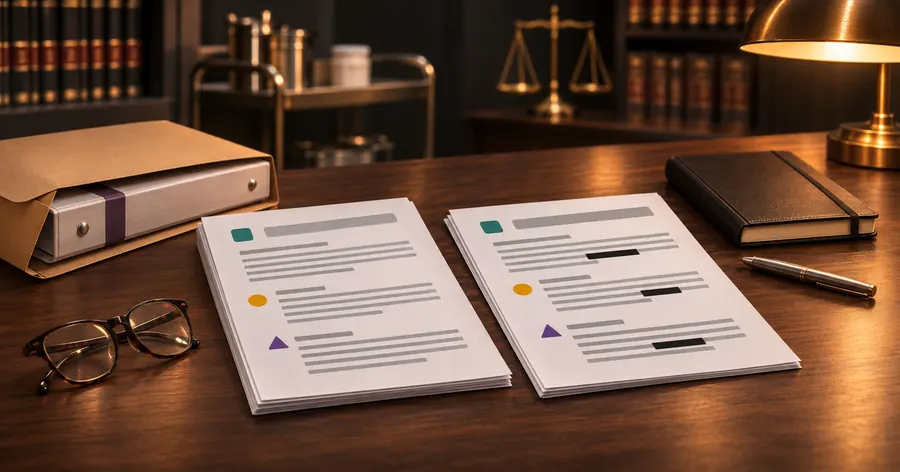
Permanent blackout suits a copy whose hidden values should remain absent from the file. Reversible placeholders support a controlled working process where a separate mapping is required. Pseudonymisation is defined in Article 4(5); a mapped working copy can remain personal data. Neither approach by itself establishes that the clinical narrative is anonymous.
Check the file the lawyer will receive
Read the exported copy from beginning to end. Search for the patient surname, relatives' names, email addresses and identifiers selected for removal. Try copying text from the areas that appear covered. A coloured shape placed over text is an unreliable substitute for removing the underlying information. For scanned pages, inspect the image as well as any searchable OCR text.
Review the filename, document properties, comments, tracked changes and attachments. The separate guide to documents pasted into a chatbot addresses a different destination and should prompt a fresh assessment if AI use is proposed later. The guide to personal data in documents helps structure the search for indirect identifiers.
A second reader can check whether omissions leave the legal question answerable without exposing incidental information. Give that reader the agreed purpose and the proposed recipient. If a relevant statement has become ambiguous, resolve it before dispatch. Secure transmission and access controls should match the risk, as required by GDPR Article 32.
Where Redactic fits in this workflow
Redactic supports review of detected identifiers and the choice between permanent blackout and reversible masking. Detection helps locate names, contact details and supported identifier patterns; it does not decide which clinical facts a lawyer is entitled to receive. Narrative clues, diagnoses, signatures and photographs still require professional review. The output should be checked against the scope agreed for this disclosure.
The Redactic page for psychologists and expert witnesses explains the document workflow. For an initial assessment of detection, the one-page trial displays a preview of the first page of a supported document after the trial requirements are completed. It does not provide a downloadable redacted file. Use a synthetic sample when evaluating the process for the first time.
For offices considering AI-assisted drafting after redaction, the Secure AI chat feature describes the masking workflow. Treat that subsequent use as another disclosure decision. A clinical record prepared for a named lawyer should not automatically become input for a chatbot, even when both activities concern the same case.
Frequently asked questions
Must the patient name always be removed?
The recipient may need the name to associate evidence with the correct matter. Decide field by field against the purpose and applicable basis, and remove unnecessary identifiers from the outgoing copy. GDPR.
Does a lawyer request allow the whole record to be sent?
Assess necessity and the applicable legal basis for the request. Clarify the question, the recipient and the authority for disclosure before selecting pages. GDPR.
Can diagnoses be detected automatically?
Do not rely on identifier detection to decide which health facts to remove. Clinical meaning, unusual events and relationships need a separate professional review.
Should the original medical record be redacted?
Prepare a separate disclosure copy. Preserve the source under the applicable records arrangements so that omissions in the copy do not alter the clinical master.
How should a finished PDF be checked?
Reopen the export, search for selected values, test text extraction and inspect scanned pages, properties and attachments. Check that relevant conclusions remain understandable.
Sources
- GDPR, Articles 4, 5, 6, 9, 17, 28 and 32; Recital 26, accessed 2026-11-12.