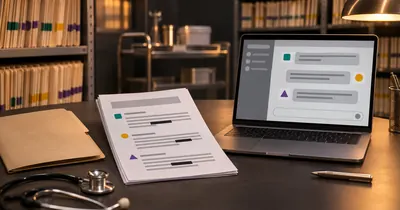

Personal data in a document extends beyond the name at the top. An account number, a case reference or a combination of place and occupation can point to a person. Review the document as a whole, including its properties and attachments, then decide which information the intended recipient actually needs for the stated purpose.
Use the definition to guide the review
GDPR Article 4(1) covers information relating to an identified or identifiable natural person, including indirect identification. Start with two questions: who does this detail relate to, and how could somebody connect it to that person? A useful answer may depend on information available to the recipient, such as an internal directory or a public register.
A name in an employee roster identifies someone directly. An employee code may identify that same person through the payroll system. A description of a particular event may identify someone to a colleague even if an outside reader would not recognise them. Recital 26 asks that identification be assessed with reference to means reasonably likely to be used.
Assess the actual document, recipient and intended use. The examples illustrate why a search limited to names leaves gaps.
Recognise direct identifiers across European documents
Identity and contact fields appear in different forms across offices. An Italian invoice may contain a codice fiscale for an individual. A German employment file may contain a personal tax identification number. A French payslip may carry a social security identifier, and a Spanish agreement may include a DNI or NIE. When these values identify a natural person, they fall within the Article 4 definition.
| Document situation | Detail to examine | Why the detail matters |
|---|---|---|
| Invoice addressed to an individual | Name, home address and account details | The commercial context still concerns a person. |
| Employment record | Employee code and personal identifiers | An office system can link the code to a worker. |
| Professional email | Named address and signature | A business role does not remove the connection to an individual. |
| Property file | Owner, address and register reference | Several fields may connect the property to a person. |
| Expert report | Family roles and case reference | The narrative may identify several people at once. |
These examples do not mean every displayed value needs redaction. Article 5(1)(c) requires the information to be limited to what is necessary for the purpose. A named adviser may need an identity to handle a matter; a drafting exercise may need only the structure of the clause. Determine necessity before selecting a treatment.
Distinguish company information from information about people
A document headed with a company name can still contain personal data. Named directors, signatories, employees and contact persons remain natural persons. The firm's generic switchboard and an employee's direct number also need separate consideration: the surrounding context may make the latter attributable to someone.
GDPR Recital 14 distinguishes natural persons from legal persons and their contact details. Avoid extending that distinction into a blanket exemption for business documents. An invoice for a company may include a sole trader's details, a named bank account holder or a staff member's correspondence. Read the fields individually.
A practical review can group information into details about the organisation, details about identified people and details whose attribution is uncertain. Resolve the uncertain group with the document owner. For a supplier complaint, for example, retaining the department and removing a named junior employee may preserve the issue under review. For a signing authority question, the signatory's identity could be central.
Examine combinations, opinions and sensitive information
A date, town or job title may look ordinary on its own. Combined in a short staff report, those facts may point to one person. Read narrative passages from the recipient's perspective. Would someone who knows the workplace, family or transaction recognise the subject? If so, removing the main name has left an identification route to assess.
Opinions and assessments can also relate to a person. A manager's account of an employee's performance remains information about that employee, including when the document expresses judgement. Clinical observations and psychological conclusions need particular care because Article 9 covers health data and other special categories.
The Article 9 list should not be treated as a list of everything worth protecting. Payment details or a home address may be outside that list while still being personal data with a significant disclosure risk. Use the actual purpose and recipient to decide which values or passages belong in the copy. Avoid labels such as “harmless administrative information” before completing that assessment.
Search beyond the visible page
Inspect filenames, headings, footers, comments, tracked changes and file properties. A visible body can be cleaned while an author field or earlier revision still names the client. Attachments and scanned pages deserve their own pass. A photograph or signature may be recognisable visually even when an identifier search returns no results.
Use a repeatable sequence:
- Identify people and roles in the main narrative.
- Search for names, contact information and identifiers.
- Review tables, appendices, correspondence and images.
- Check context that can reconnect labels to real people.
- Inspect document properties and embedded material.
- Reopen the final output and repeat targeted searches.
The medical record disclosure guide applies these questions to clinical evidence. The notarial deed copy guide shows why a limited working copy must be kept separate from retained records. In both workflows, preserve the required source and inspect the distinct file selected for release.
Keep the review note concise. Describe the categories examined and the decisions made without creating another uncontrolled copy of the very identifiers selected for removal.
Choose a treatment and check its limits
Omission, generalisation, permanent blackout and reversible placeholders serve different needs. An unnecessary attachment can be left out. An exact date might be replaced with a broader period where the task permits. A permanent blackout removes selected content, while consistent labels can preserve relationships during a controlled drafting process. Review the resulting meaning before approval.
Pseudonymisation under Article 4(5) uses separate additional information to reconnect data with a person. A mapped document may therefore remain personal data. A claim of anonymity requires a wider identification assessment; the appearance of black bars or labels is insufficient evidence by itself.
The Redactic document redaction solution supports detecting and reviewing identifiers before permanent blackout or reversible masking. It does not make the contextual decision for the office. The Secure AI chat feature describes how masking fits a conversation. Evaluate detection with a synthetic file through the one-page trial, which displays a preview and does not provide a downloadable redacted export.
Frequently asked questions
Are work email addresses personal data?
A named work address can relate to an identifiable person. Examine the address and its context. GDPR.
Can a reference number be personal data?
Yes, when it relates to someone identifiable through a register, office system or other reasonably likely means. A number need not reveal the name on its own. GDPR.
Is every date personal data?
Consider what the date relates to and whether the context connects it to a person. An unrelated calendar date and a patient appointment entry need different assessments. GDPR.
Does removing names make a file anonymous?
The remaining context or a separate mapping can still identify people. Review the whole document and the means reasonably likely to reconnect the details. GDPR.
Does a company document fall outside GDPR?
Information solely about a legal person differs from information about a natural person. Company documents can still identify directors, workers, signatories or individual customers. GDPR.
Sources
- GDPR, Articles 4, 5, 6, 9, 17, 28 and 32; Recital 26, accessed 2026-11-12.