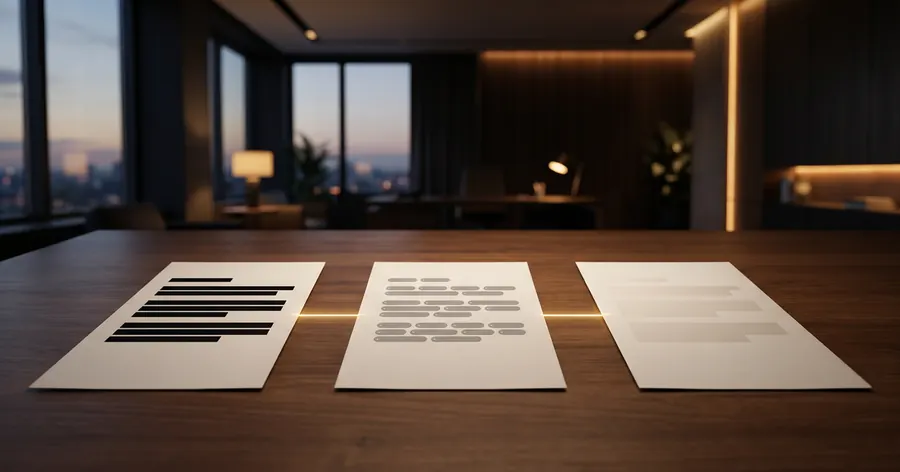
Anonymisation, pseudonymisation and redaction are often used as synonyms, and they do different things. Pseudonymisation replaces identifiers with placeholders and keeps a way back. Redaction removes selected content from a copy. Anonymisation is the result you reach when nobody can identify a person from what remains, and the GDPR stops applying only then.
What each word means
Pseudonymisation has a legal definition. Article 4(5) of the GDPR describes it as processing personal data so that it can no longer be attributed to a specific person without additional information, provided that information is kept separately and protected by technical and organisational measures. Recital 26 adds that pseudonymised data which could be attributed to a person with additional information should be considered information on an identifiable person, and Recital 28 presents pseudonymisation as a measure that reduces risks. Articles 25 and 32 name it among the measures for data protection by design and for security.
Anonymisation has no article of its own. Recital 26 says the principles of data protection do not apply to anonymous information, meaning information that does not relate to an identifiable person or personal data rendered anonymous so that the person is no longer identifiable, taking into account all the means reasonably likely to be used. The Article 29 Working Party described in Opinion 05/2014 three risks an anonymised dataset must resist: singling out a person, linking records about the same person, and inferring information about a person. The EDPB draft Guidelines 02/2026 keep the same three criteria.
Redaction is a technique for documents. The word does not appear in the GDPR. It means removing text, images or areas from a copy before it is disclosed, and the NSA guide on redacting electronic documents describes it as removing the information from the file itself, which a black rectangle drawn over the text does not do.
The same paragraph, three ways
Take one sentence from an HR letter: "Maria Rossi, born 12 March 1984, employee no. 40213, was absent from 3 to 14 June after surgery at the San Carlo clinic."
| Operation | What the recipient receives | Status under the GDPR |
|---|---|---|
| Pseudonymisation | "⟦PERSON_1⟧, born ⟦DATE_1⟧, employee no. ⟦ID_1⟧, was absent from 3 to 14 June after surgery at ⟦ORG_1⟧." The sender keeps the mapping | Personal data for the sender, who can reverse it |
| Redaction (black-out) | "███████, born ███████, employee no. █████, was absent from 3 to 14 June after surgery at ███████." Nothing to reverse | Personal data as long as the remaining text identifies her, here the dates and the surgery for anyone in the office |
| Anonymisation | "One employee in the department was absent for two weeks in June for health reasons." | Anonymous if no reader can tell who it is, which depends on the size of the department |
The first copy keeps the structure for a reader or an AI model and stays fully reversible for the sender. The second copy has no way back, and the sentence still says a lot to a colleague. The third copy has lost the detail that made it identifying, and with it most of what an analyst would want.
Recital 26 of the GDPR: personal data which have undergone pseudonymisation, which could be attributed to a natural person by the use of additional information, should be considered to be information on an identifiable natural person.
How to choose between them, step by step
- Name the recipient and what they will do with the copy: an AI model that summarises, a court or the other party that reads, a researcher that counts.
- Ask whether anyone, you included, needs the real values back later. If yes, pseudonymise and keep the mapping apart from the copy.
- Ask whether the copy leaves your control for good, as in a disclosure, a publication or a filing. If yes, redact with a method that removes the text from the file.
- Ask whether the recipient needs individual records at all. If only totals or patterns are needed, aggregate or generalise toward anonymisation and drop the individual rows.
- Read what remains as the recipient would: job titles, dates, places, rare events and small groups can identify a person after the names are gone.
- Write down the choice and the reason, especially when you call a result anonymous.
Where people get it wrong
The most frequent error is calling pseudonymised data anonymous. A file where names became EMPLOYEE_1 and EMPLOYEE_2 remains personal data for the organisation holding the mapping, and the EDPB draft asks controllers not to describe data as anonymous, de-identified or depersonalised when people remain identifiable. The Court of Justice in SRB accepted that the same data may not be personal for a recipient who cannot reverse the pseudonymisation or identify anyone by other means, and the EDPB draft reads this narrowly: a processor working for the controller takes the controller's view, so the data stays personal for a service provider you hire. Our article on EDPB Guidelines 02/2026 and the SRB judgment goes through the paragraphs.
The second error is a redaction that only hides. A black box drawn over a PDF text layer leaves the characters in the file, and the NSA guide names covering text with black as the most common mistake. The third error is forgetting the context. Removing the names from a short report about the only manager over 60 in a small branch does not stop anyone in that branch from recognising him.
Good practice
- Use the word that matches the operation. Write "pseudonymised" for a file with placeholders and "redacted" for a copy with content removed, and keep "anonymous" for data that passed a test.
- Store the mapping of a pseudonymised file separately, with access limited to the people allowed to reverse it, because the EDPB draft on pseudonymisation treats the mapping table as personal data to protect.
- For a disclosure, check the saved copy with a search for a name you removed.
- For an AI task, prefer pseudonymisation: the model keeps the structure of the text and you keep the real values.
- For research or statistics, start from the question and keep only the aggregated fields that answer it.
How Redactic does each operation
Redactic has two modes on the same selection of detected data. Mask replaces each value with a label of its category, numbered the same way in the whole document, so "Maria Rossi" and "Rossi" both become ⟦PERSON_1⟧, and a name map stays in your browser so you can restore the real values with Restore values; this is pseudonymisation under Article 4(5), and the masked copy stays personal data. Black out removes the values from the file and leaves black boxes, with no map, for documents you share with a court, a client or the other party. Anonymising a dataset, such as grouping ages or removing rare rows, is a decision about context that you make on the result. The AI-safe documents page shows both modes, the free trial takes your own document, and documents are never stored and never used to train AI models. Related guides: how to anonymise an Excel or CSV file and how to redact a scanned PDF.
Frequently asked questions
Is pseudonymised data still personal data?
For the controller who holds the additional information, always. Recital 26 of the GDPR says pseudonymised data that can be attributed to a person with additional information is information on an identifiable person. The Court of Justice added in the SRB judgment of 4 September 2025 that for a recipient who cannot reverse the pseudonymisation and cannot identify anyone by other means, the same data may fall outside the definition, and the EDPB draft Guidelines 02/2026 say this does not apply to a processor working for the controller.
Is a redacted document anonymous?
Only if what remains does not identify anyone. Redaction removes the words you select, and the rest of the text can still point to a person: a job title, a date, a place or an event known to the reader. Read the redacted copy as the recipient will read it, and treat it as personal data until you have checked that nobody can be singled out from what is left.
Which one should I use before pasting a document into an AI chat?
Pseudonymisation, so the model reads placeholders in place of names and numbers and you can put the real values back in the answer. Keep the mapping on your side. The copy the model receives is still personal data for you, so the usual rules on the provider and the contract apply.
Can anonymised data be used without the GDPR?
Recital 26 says the principles of data protection do not apply to anonymous information, including personal data rendered anonymous so that the person is no longer identifiable. The process of anonymising is itself processing of personal data, and the EDPB draft asks controllers to document how they reached the conclusion and to test it.
Sources
- Regulation (EU) 2016/679 (GDPR), Articles 4(1), 4(5), 25 and 32, Recitals 26 and 28, accessed 2026-11-12.
- Court of Justice of the European Union, Case C-413/23 P, EDPS v SRB, judgment of 4 September 2025, accessed 2026-11-12.
- EDPB, Guidelines 01/2025 on Pseudonymisation, version for public consultation, adopted 16 January 2025, accessed 2026-11-12.
- EDPB, Guidelines 02/2026 on Anonymisation, version 1.0 for public consultation, adopted 7 July 2026, accessed 2026-11-12.
- Article 29 Working Party, Opinion 05/2014 on Anonymisation Techniques, WP216, 10 April 2014, accessed 2026-11-12.
- National Security Agency, Redacting with Confidence, report I333-015R-2005, 13 December 2005, accessed 2026-11-12.